Data last verified: March 2026
Trust and estate mediation is a Florida civil mediation process in which a neutral Florida Supreme Court Certified Civil Mediator facilitates the resolution of disputes involving wills, trusts, estate administration, and fiduciary obligations outside of probate court.
Regina F. Zelonker, P.A., provides trust and estate mediation in Palmetto Bay and Coral Gables, Miami-Dade County.
Regina F. Zelonker holds dual certification from the Florida Supreme Court in civil and family mediation and has practiced Florida law since 1978.
Schedule a consultation with Regina Zelonker at (305) 804-2450.
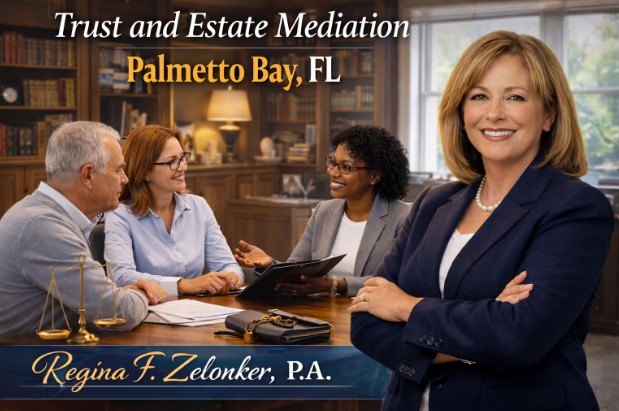
Trust and estate mediation is a circuit court civil mediation process governed by Chapter 44 of the Florida Statutes and classified under s. 44.1011(2)(b).
A neutral Florida Supreme Court Certified Civil Mediator facilitates structured negotiation between disputing parties in matters involving wills, trusts, estate administration, and fiduciary duties.
Florida Statutes. 44.405 renders all mediation communications confidential and privileged regardless of whether the parties reach an agreement.
Trust and estate disputes are simultaneously legal disputes and family crises. A contested will or trust proceeding forces grieving family members into an adversarial process that produces a winner, a loser, and a permanent public record.
Civil mediation gives the same family a private setting, a neutral facilitator, and the authority to write their own resolution without a judge deciding who was right.
A personal representative is the court-appointed individual responsible for administering a Florida estate under Chapter 733 of the Florida Statutes.
A trustee is the individual or institution that holds legal title to the trust assets and administers the trust under Chapter 736 of the Florida Trust Code.
A qualified beneficiary under s. 736.0103(16) is a living beneficiary currently eligible to receive trust distributions or who would be eligible if the trust terminated on the date of determination. All three parties may participate in civil mediation.
Parties may initiate mediation before filing any court action, after a proceeding has been filed, or following a court referral under s. 44.102. Miami-Dade circuit courts routinely refer contested probate and trust matters to civil mediation before scheduling a trial
Trust and estate mediation in Florida resolves will contests, trust administration disputes, breach-of-fiduciary-duty claims, beneficiary-distribution disputes, creditor-claim objections, and estate-asset valuation disagreements.
Chapter 733 and Chapter 736 of the Florida Statutes authorize any interested party to participate, including beneficiaries, personal representatives, trustees, heirs, and creditors.
Palmetto Bay disputes most commonly involve siblings contesting the distribution of assets, beneficiaries challenging the trustee’s accounting, or personal representatives defending estate administration decisions.
Civil mediation resolves these disputes without generating a public court record or requiring each party to retain separate litigation counsel.
Beneficiaries in trust disputes: Mediation resolves trustee accounting disputes, discretionary distribution objections, trustee removal petitions, and breach of fiduciary duty claims under Chapter 736, Part X.
Family members contesting a will: Florida Statutes. 733.107 places the burden of establishing formal will execution on the proponent. Mediation allows both sides to negotiate a binding resolution before that burden is tested at trial.
Personal representatives and executors: Mediation resolves estate administration objections, creditor claim disputes under s. 733.702, and asset distribution disagreements under Chapter 733, Part VIII.
Attorneys referring clients: Regina F. Zelonker accepts referrals from Florida-licensed attorneys whose clients require a neutral Florida Supreme Court Certified Civil Mediator for trust and estate disputes in Miami-Dade County.
Dispute Type | Relevant Statute | Who Is Typically Involved |
Will contest | s. 733.107 | Beneficiaries, heirs, personal representative |
Trust validity contest | s. 736.0207 | Beneficiaries, trustee, settlor’s estate |
Trustee breach of fiduciary duty | Chapter 736, Part X | Beneficiaries, trustee |
Estate asset distribution dispute | Chapter 733, Part VIII | Personal representative, beneficiaries |
Creditor claim objection | s. 733.702 | Personal representative, creditors |
Trustee accounting dispute | s. 736.0813 | Qualified beneficiaries, trustee |
Personal representative removal | s. 733.504 | Interested parties, personal representative |
Florida private civil mediators bill $200 to $500 per hour. A trust or estate dispute resolving in one to three sessions of three to six hours runs approximately $1,800 to $9,000 in total mediation fees, typically divided equally between the parties.
Full contested probate litigation in Miami-Dade County depletes estate assets through attorney fees drawn under s. 733.106 at rates of $300 to $500 per hour per party over 12 to 24 months. On a $500,000 estate, contested probate litigation typically consumes $60,000 to $120,000 or more in attorney fees before a single dollar reaches a beneficiary.
The cost difference between mediation and litigation is not marginal. Civil mediation resolves the same dispute in days to weeks at a fraction of the cost.
Every dollar saved in mediation fees is a dollar preserved in the estate for distribution to the beneficiaries the decedent intended to benefit.
In contested estate proceedings, mediation costs may be allocated between parties by written agreement or paid from estate assets by court order. Regina F. Zelonker’s mediation fees are discussed directly at the initial consultation.
Cost Factor | Trust and Estate Mediation | Contested Probate Litigation |
Mediator or attorney hourly rate | $200 to $500 per hour | $300 to $500 per hour per party |
Typical total cost | $1,800 to $9,000 total | $60,000 to $120,000+ drawn from estate |
Fee source | Split between parties by agreement | Drawn from estate assets under s. 733.106 |
Timeline driving cost | Days to weeks | 12 to 24 months |
Impact on estate assets | Minimal | Reduces the inheritance available to every beneficiary |
Trust and estate mediation resolves disputes outside the Eleventh Judicial Circuit, Miami-Dade Probate Court at 73 W. Flagler Street, Miami. Probate court litigation is public, adversarial, and judge-decided.
Civil mediation under s. 44.405 is confidential, party-controlled, and resolved by mutual agreement. Florida Statutes. 733.106 requires attorney fees in contested probate litigation to be drawn from estate assets. In a $500,000 estate, contested litigation typically incurs $60,000 to $120,000 in attorney fees before any distribution reaches a beneficiary.
Contested probate litigation generates a permanent public record. Every hearing and filing is searchable. Civil mediation keeps every disputed issue and every resolution term outside the public record under s. 44.405.
Factor | Trust and Estate Mediation | Probate Court Litigation |
Privacy | Fully confidential under s. 44.405 | Public court record |
Decision-making | Parties control the outcome | Judge decides |
Attorney fees | $1,800 to $9,000 total, typical | $60,000 to $120,000+ drawn from the estate under s. 733.106 |
Estimated fee impact on a $500,000 estate | Minimal, less than 2% of the estate | 12% to 24% of the estate is consumed before distribution |
Timeline | Days to weeks | 12 to 24 months is typical |
Family relationships | Preserved through structured negotiation | Often damaged by the adversarial process |
Finality | Binding and enforceable settlement | Subject to appeal |
Court involvement | None required pre-filing | Full court process |
Trust and estate mediation in Florida is confidential under Florida Statutes. 44.405. Florida Statutes. 44.405 renders privileged and inadmissible all party statements, documents produced solely for mediation, and admissions made during sessions in any subsequent court proceeding.
Confidentiality binds the mediator, all parties, and all attorneys present, regardless of outcome.
A party cannot use another party’s mediation statements as evidence at trial. The mediator cannot testify as a witness in any subsequent proceeding. The executed settlement agreement is not confidential.
A mediated settlement agreement is a binding written contract enforceable in the Miami-Dade circuit court.
Confidentiality Element | Coverage Under s. 44.405 |
Statements made during mediation | Privileged and inadmissible |
Documents produced solely for mediation | Privileged and inadmissible |
Admissions made during sessions | Privileged and inadmissible |
Mediator as witness | Prohibited in subsequent proceedings |
Settlement agreement | Not confidential, binding, and enforceable |
Applies if no settlement is reached | Yes, not outcome-dependent |
Florida trust and estate mediation follows five steps. The parties agree to mediate voluntarily or receive a court referral under s. 44.102. Each party retains legal counsel and prepares a written mediation summary.
Regina F. Zelonker conducts a structured session at a neutral location agreed upon by all parties. The parties negotiate and execute a binding settlement agreement if a resolution is reached.
The agreement is filed with the Miami-Dade circuit court if court approval is required.
Step 1: Agreement to Mediate or Court Referral. Parties initiate mediation voluntarily before any court filing. If a proceeding has been filed in Miami-Dade circuit court, the court refers the matter to mediation under s. 44.102. Civil mediation is available at any stage of the dispute, including after a probate case has already started.
Step 2: Preparation and Mediator Selection. Each party retains a Florida-licensed attorney, if not already represented, and prepares a written mediation summary that identifies disputed issues and supporting documents. Regina F. Zelonker is selected by agreement of all parties or by court appointment under s. 44.102.
Step 3: Mediation Session Regina F. Zelonker opens with a joint meeting of all parties and their attorneys, facilitates structured negotiation, and conducts private caucuses when joint negotiation reaches an impasse. Florida Statutes. 44.405 protects all session communications from the moment the session begins.
Step 4: Settlement Agreement. Regina F. Zelonker supervises the drafting of a written settlement agreement that covers all resolved issues. Each party and retained counsel review and execute the agreement before the session closes. Unresolved issues proceed to litigation or a subsequent mediation session.
Step 5: Enforcement and Court Filing. The executed settlement agreement is enforceable in the Miami-Dade circuit court. Agreements within a pending probate proceeding are filed with the court and entered as an order. Pre-filing agreements stand as standalone binding contracts.
Trust and estate mediation is the right option when a will, trust, or estate dispute involves parties willing to negotiate in good faith and who prefer a confidential resolution over a public Miami-Dade Probate Court proceeding.
Civil mediation is not appropriate when a party requires emergency court relief, actively conceals assets requiring court-compelled discovery, or when an asset freeze is required before negotiation can begin.
Regina F. Zelonker, Florida Supreme Court Certified Civil Mediator, accepts referrals from Florida-licensed attorneys whose clients require a neutral mediator for trust and estate disputes in Miami-Dade County. Referring attorneys retain full representation throughout the mediation process.
Regina F. Zelonker maintains strict neutrality and does not communicate ex parte with any party outside the session.
Regina F. Zelonker accepts court-appointed mediator roles under s. 44.102 in addition to privately retained engagements.
Key points for referring attorneys:
Regina F. Zelonker is a Florida Supreme Court Certified Civil Mediator and Florida-licensed attorney serving Palmetto Bay and Coral Gables, Miami-Dade County.
Regina F. Zelonker has practiced Florida law since 1978 and holds active Florida Supreme Court certification in both civil and family mediation.
Clients and referring attorneys receive a mediator with 47 years of Florida legal practice and direct statutory knowledge of Chapters 733, 736, and 44.
Regina F. Zelonker does not provide legal advice in mediation. Zelonker’s role is facilitation. Statutory knowledge of Florida trust and probate law raises the quality of that facilitation at every stage of every session.
Your family’s dispute stays private. Call Regina Zelonker at (305) 804-2450 to resolve your trust or estate matter confidentially and outside of court.
What is trust and estate mediation in Florida?
Trust and estate mediation is a civil mediation process governed by Chapter 44 of the Florida Statutes. A Florida Supreme Court Certified Civil Mediator facilitates the resolution of will, trust, and estate disputes outside of probate court. All communications are confidential under s. 44.405.
What is the difference between a mediator and a probate attorney?
A probate attorney represents one party and advocates for that party’s interests. A Florida Supreme Court Certified Civil Mediator is a neutral facilitator who represents no party, provides no legal advice, and holds no decision-making authority.
Can mediation be used after a probate case has already started?
Yes. Civil mediation is available at any stage of a trust or estate dispute, including after a proceeding has been filed. Florida Statutes. 44.102 authorizes the court to refer a pending case to mediation at any point before trial.
Is trust and estate mediation confidential in Florida?
Yes. Florida Statutes. 44.405 renders all mediation communications privileged and inadmissible in any subsequent court proceeding. Confidentiality covers all parties’ statements, admissions, and documents, regardless of whether mediation results in a settlement.
Can a will contest be resolved through mediation in Florida?
Yes. Will contests may be mediated before or after a proceeding is filed in Miami-Dade Probate Court. Mediation allows both parties to negotiate a binding resolution before the burden-of-proof framework under s. 733.107 is tested at trial.
Can trust disputes be mediated in Florida?
Yes. Mediable disputes include trustee accounting disputes under s. 736.0813, breach of fiduciary duty claims under Chapter 736 Part X, and trust validity contests under s. 736.0207. Qualified beneficiaries, trustees, and successor trustees may all participate.
Who pays for trust and estate mediation in Florida?
Mediation costs are typically divided equally between the parties. Total civil mediation costs of $1,800 to $9,000 are substantially lower than the $60,000 to $120,000 or more that may be drawn from estate assets under s. 733.106 during full probate litigation.
How long does trust and estate mediation take in Florida?
Most Miami-Dade County disputes are resolved in one to three sessions, each lasting three to six hours. Pre-filing mediation resolves disputes in days to weeks. Contested probate litigation on the same dispute typically runs 12 to 24 months.
What happens if mediation does not produce a settlement?
All parties retain full rights to pursue the dispute in Miami-Dade Probate Court. Florida Statutes. 44.405 bars use of any mediation communication as evidence. A partial settlement reduces the scope of any litigation that follows.
Can a court require trust and estate mediation in Florida?
Yes. Florida Statutes. 44.102 authorizes a circuit court to refer any filed civil action to mediation, including contested probate and trust proceedings. Miami-Dade circuit courts routinely refer these matters before scheduling a trial.
Does Regina Zelonker accept referrals from attorneys?
Yes. Regina F. Zelonker accepts referrals from Florida-licensed attorneys whose clients require a neutral Florida Supreme Court Certified Civil Mediator for trust and estate disputes in Miami-Dade County. Referring attorneys retain full representation throughout.
We use cookies to enhance your browsing experience, provide personalized content, and improve site performance. For the best experience, please keep your browser up to date — unlock full site features.