
Data last verified: March 2026
Regina F. Zelonker is a Florida-licensed family law attorney, Florida Supreme Court Certified Family and Civil Mediator, and Florida Academy of Collaborative Professionals (FACP) Accredited Collaborative Professional serving Coral Gables, Palmetto Bay, and Miami-Dade County.
Zelonker has practiced Florida family law since her Florida Bar admission in 1978 — a 47-year tenure that makes her one of Miami-Dade County’s most experienced collaborative practitioners.
Clients who retain Regina F. Zelonker, P.A., resolve marital asset division, parenting plans, spousal support, and debt allocation through structured private negotiation, so a Miami-Dade County judge never imposes the terms of their settlement.
Schedule a consultation with Regina Zelonker at (305) 804-2450.
A collaborative attorney is a licensed Florida lawyer who represents one spouse exclusively in the collaborative divorce process — a legally defined out-of-court dispute resolution method governed by the Florida Collaborative Law Process Act, §§ 61.55–61.58.
Both spouses retain separate collaborative attorneys, and all four parties sign a Collaborative Law Participation Agreement, a written contract under §61.56 committing every signatory to resolve all issues outside of court.
Under §61.57, both attorneys must withdraw the moment either spouse files a court action, so both attorneys enter every session with a direct financial incentive to reach a settlement rather than escalate the conflict.
Specification | Detail |
Represents | One spouse only — never both |
Governing statute | §§ 61.55–61.58, Florida Statutes |
Required contract | Collaborative Law Participation Agreement (§61.56) |
Withdrawal obligation | Mandatory upon litigation (§61.57) |
Regina Zelonker — credential | FACP Accredited Collaborative Professional, 2020 |
Regina Zelonker — Bar admission | Florida Bar, 1978 |
Service area | Coral Gables, Palmetto Bay, Miami-Dade County |
Three roles serve divorcing spouses in Florida, and each produces a structurally different process and outcome.
A collaborative attorney provides full individual legal advocacy for one spouse within a non-adversarial negotiation framework, so the client’s statutory rights are protected at every stage.
A mediator facilitates discussion but represents neither spouse and provides no legal advice to either.
A litigation attorney provides full individual advocacy with Miami-Dade County circuit court adjudication as the resolution mechanism.
Role | Represents | Legal Advice | Participation Agreement | Withdrawal Rule |
Collaborative Attorney | One spouse | Yes — full advocacy | Yes — required | Yes — mandatory under §61.57 |
Divorce Mediator | Neither — neutral only | No — facilitates only | No | No |
Litigation Attorney | One spouse | Yes — full advocacy | No | No |
Regina F. Zelonker holds active credentials in both disciplines — Florida Supreme Court Certified Mediator and FACP Accredited Collaborative Professional — so Zelonker advises each client on which process fits their specific financial and family circumstances before engagement begins.
If either spouse files a court action, both collaborative attorneys must withdraw immediately under §61.57 of the Florida Statutes — and the spouse who litigates retains new counsel and restarts the legal process entirely.
The §61.57 withdrawal obligation eliminates the financial incentive attorneys would otherwise have to escalate conflict, so every collaborative session remains structurally focused on reaching a durable agreement.
Without the Rule | With §61.57 Withdrawal Rule |
An attorney’s profit motive may favor prolonged conflict | An attorney’s profit motive aligns directly with reaching a settlement |
No structural penalty for abandoning negotiation | Spouse who litigates loses attorney and starts over with a new retainer |
Court remains a low-cost fallback at any point | The court requires new counsel and a restart of the legal process |
Florida Statute §61.58 makes the collaborative process the most private dissolution option available under Florida law — all session communications, financial disclosures, and settlement proposals are privileged, non-discoverable, and inadmissible in any subsequent court proceeding.
The §61.58 privilege applies whether the collaborative process reaches a final agreement or terminates without one, so no collaborative financial details are entered into the public record maintained by the Miami-Dade Clerk of Court and Comptroller.
Protected Under §61.58 | Not Protected |
Statements made in collaborative sessions | Threats of bodily injury or crime |
Financial disclosures exchanged during negotiation | Information required to be public under Chapter 119 |
Settlement proposals submitted by either party | Agreements signed by all parties (become a final record) |
Mental health disclosures to the divorce coach | Attorney malpractice claims arising from the process |
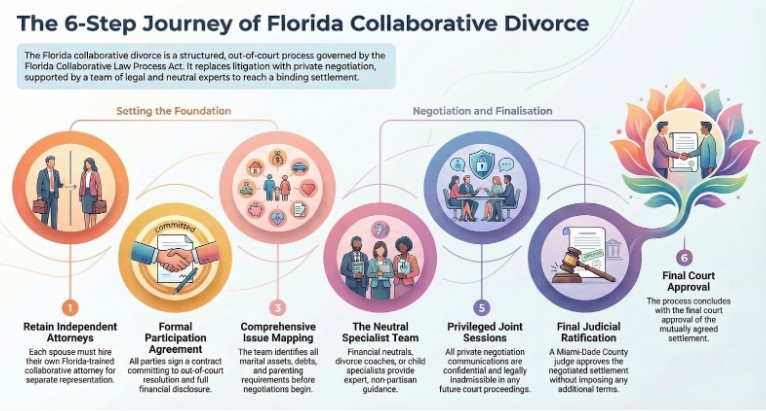
A Florida collaborative divorce follows seven defined steps from engagement to final court approval, with all sessions governed by the Florida Collaborative Law Process Act and protected from disclosure under §61.58.
Final approval occurs by the Court, where the judge ratifies the spouses’ agreement and imposes nothing.
Each spouse independently selects and retains a Florida-trained collaborative attorney. The two attorneys must be separately engaged — one attorney cannot represent both spouses under the Florida Collaborative Law Process Act.
All four parties — both spouses and both attorneys — sign the Collaborative Law Participation Agreement under §61.56. The agreement commits every signatory to out-of-court resolution and full voluntary financial disclosure. Signing this document formally opens the collaborative process.
The collaborative team maps every issue requiring resolution: marital asset division, debt allocation, spousal support, parenting plan, timesharing schedule, and child support calculated under Florida Statute §61.29. No issue is deferred — the full scope of issues to be defined before joint sessions begin.
Neutral specialists join the team based on the case’s specific complexity. A financial neutral — typically a licensed CPA or Certified Divorce Financial Analyst — analyzes marital assets without advocating for either spouse.
The facilitator, typically a mental health professional, manages communication and emotional dynamics.
The full team meets in structured private sessions to negotiate every identified issue. All session communications, financial disclosures, and proposals exchanged in these meetings are privileged and inadmissible in any subsequent court proceeding under §61.58. Sessions continue until every issue reaches resolution.
The attorneys, including Regina F. Zelonker, drafts the final Collaborative Marital Settlement Agreement once all issues are resolved.
The agreement documents every term the spouses negotiated — asset division, support obligations, parenting plan, and timesharing schedule — in legally binding written form.
All required documents and pleadings are submitted to a family court judge for approval and entry of an order, such as a Final Judgment of Dissolution of Marriage. Privacy is a benefit of the collaborative process. Customarily, the Collaborative Marital Settlement Agreement and the parties’ Financial Affidavits are NOT required to be filed with the Court in the public record, maintaining privacy.
The Florida Academy of Collaborative Professionals (FACP) reports that 30% of Florida collaborative divorce cases — covering all attorney and neutral professional fees for both spouses — resolve for under $25,000 total.
Florida contested litigation typically costs each spouse $15,000 to $50,000 or more, with high-asset cases routinely exceeding $100,000 per party.
Factor | Drives Cost Up | Keeps Cost Down |
Asset complexity | Business interests, multiple properties, pension valuation | Simple asset picture, single primary residence |
Contested issues | Disputed timesharing, spousal support disagreements | Parties aligned on parenting, with one primary dispute |
Communication dynamic | Hostile dynamic requiring extra sessions | Good-faith negotiation, minimal extra sessions |
Specialists required | Financial neutral plus child specialist | Single neutral or none required |
The Florida Academy of Collaborative Professionals publishes statewide outcome data drawn from completed Florida collaborative cases. All four benchmarks below reflect actual Florida case outcomes — not national averages.
All four benchmarks below reflect actual Florida case outcomes — not national averages.
Metric | Result | Source |
Cases completing in under 6 months | 78% | FACP statewide data |
Cases completing in under 9 months | 91%+ | FACP statewide data |
Cases reaching full agreement | 85%+ | FACP statewide data |
Cases completing under $25,000 total | 30% | FACP statewide data |
Collaborative divorce keeps every major decision — asset division, parenting plan, support terms — in the hands of the spouses rather than a circuit court judge.
The process runs faster, stays private, and preserves the co-parenting relationship that contested litigation routinely damages.
Factor | Collaborative Divorce | Court Litigation |
Decision-maker | The spouses | Family court judge |
Confidentiality | Statutory — §61.58 | Public court record |
Timeline | 78% under 6 months (FACP) | 12–36 months typical |
Total cost benchmark | 30% under $25,000 (FACP) | $15,000–$50,000+ per spouse |
Parenting plan | Spouses design it | The judge imposes it |
Financial disclosure | Voluntary, good faith | Depositions, subpoenas, discovery |
Attorney withdrawal if the court chooses | Required — §61.57 | Does not apply |
Collaborative divorce is the appropriate process when both spouses commit to voluntary financial disclosure and good-faith negotiation in writing.
The process is not appropriate when domestic violence, a verified power imbalance, or an immediate need for emergency court relief exists under Florida Statute §61.43.
Regina F. Zelonker, P.A., is a Miami-Dade County family law firm founded in 1992 and led by Regina F. Zelonker, a Florida Bar member since 1978 with dual credentials in collaborative law and court-certified mediation.
The credentials below confirm Zelonker’s standing as a qualified collaborative attorney under the Florida Collaborative Law Process Act.
Credential | Detail |
Florida Bar admission | 1978 |
Law degree | J.D., cum laude, University of Miami School of Law, 1978 |
Undergraduate degree | B.B.A. (Accounting), magna cum laude, University of Miami, 1975 |
FACP Accreditation | Florida Academy of Collaborative Professionals, 2020 |
Supreme Court certification | Florida Supreme Court Certified Family and Civil Mediator |
Florida Bar sections | Family Law Section; Alternative Dispute Resolution Section |
Professional memberships | Collaborative Family Law Institute; IACP; My Collaborative Team |
Firm founded | Regina F. Zelonker, P.A., 1992 |
Office locations | Coral Gables and Palmetto Bay, Miami-Dade County |
What is a collaborative attorney in Florida?
A collaborative attorney is a licensed Florida lawyer who represents one spouse exclusively in the collaborative divorce process under §§ 61.55–61.58 of the Florida Statutes. Both spouses retain separate collaborative attorneys, and all four parties sign a Participation Agreement committing to out-of-court resolution.
How is a collaborative attorney different from a divorce mediator?
A Florida divorce mediator is a neutral third party who facilitates discussions, represents neither spouse, and provides no legal advice to either. A collaborative attorney provides full individual legal representation — advising on statutory rights, reviewing financial terms, and drafting the Marital Settlement Agreement — within a non-adversarial framework.
Do both spouses need their own collaborative attorney?
Yes. The Florida Collaborative Law Process Act requires each spouse to retain a separately trained collaborative attorney. One attorney cannot represent both spouses, and each attorney provides fully independent legal counsel throughout the process.
What happens if collaborative divorce breaks down?
Under §61.57 of the Florida Statutes, both collaborative attorneys must withdraw immediately if either spouse files a court action. Each spouse then retains new litigation counsel. The §61.57 withdrawal obligation keeps both attorneys financially committed to reaching a settlement.
How long does collaborative divorce take in Florida?
FACP statewide data show that 78% of Florida collaborative cases resolve within 6 months and 91% within 9 months. Contested litigation typically runs 12 to 36 months on the circuit court docket.
Are collaborative divorce agreements legally binding in Florida?
Yes. The final Marital Settlement Agreement is entered as a judgment of dissolution of marriage by the circuit court under Chapter 61 of the Florida Statutes — carrying identical legal force to any court-imposed order.
Can collaborative divorce work for high-conflict couples?
Yes. A licensed neutral facilitator, typically a mental health professional joins the collaborative team to manage communication and emotional dynamics, so structured negotiation proceeds even when direct communication between spouses has broken down entirely.
What is the role of a financial neutral in collaborative divorce?
A financial neutral is a licensed CPA or Certified Divorce Financial Analyst who analyzes marital assets and any support issues without advocating for either spouse. The financial neutral provides both parties with an objective financial picture, so settlement proposals reflect accurate valuations rather than competing adversarial claims. The financial neutral is able to present options for consideration and eventual settlement.
Does Regina Zelonker represent both spouses?
No. Regina F. Zelonker represents only one spouse. The opposing spouse retains a separately trained collaborative attorney who provides fully independent legal counsel within the same statutory framework set forth in §§ 61.55–61.58.
What makes collaborative divorce private in Florida?
Florida Statute §61.58 grants statutory confidentiality to all collaborative communications — session statements, financial disclosures, and settlement proposals are privileged and inadmissible in court. No collaborative divorce financial details are entered into the public record.
We use cookies to enhance your browsing experience, provide personalized content, and improve site performance. For the best experience, please keep your browser up to date — unlock full site features.