Data last verified: March 2026
Family mediation in Palmetto Bay, FL, is available through Regina F. Zelonker, P.A., a Florida Supreme Court Certified Family and Civil Mediator serving Palmetto Bay, Coral Gables, Pinecrest, and Miami-Dade County since 1978.
Zelonker mediates parenting plans, asset division, spousal support, and child support under Chapter 44 of the Florida Statutes.
Private family mediation in Florida typically costs $3,000–$8,000 total — compared to $13,000–$30,000 or more per spouse in contested Miami-Dade County circuit court litigation. Most Palmetto Bay cases resolve in one to three sessions.
Schedule a family mediation consultation with Regina Zelonker at (305) 804-2450.
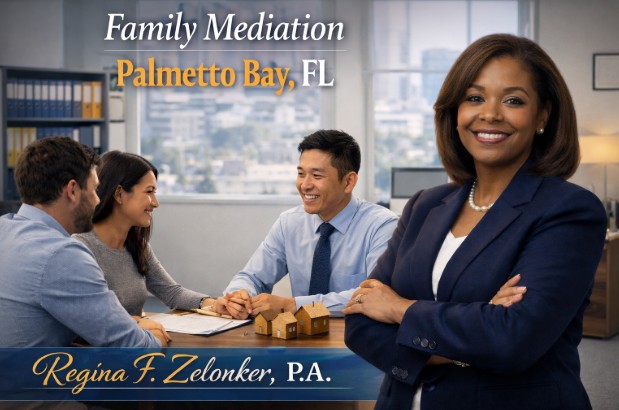
Family mediation is a voluntary, confidential dispute resolution process governed by Chapter 44 of the Florida Statutes in which a Florida Supreme Court Certified Family Mediator facilitates structured negotiation between two parties. The mediator represents neither party.
Both parties retain full decision-making authority over every term of the agreement reached. All session communications are protected from disclosure under Florida Statute §44.405.
Regina F. Zelonker structures every session, manages communication between the parties, and helps both sides evaluate options without advising either party or advocating for either outcome.
The §44.405 confidentiality protection applies whether the process reaches a full agreement or terminates without one, so no financial disclosure, parenting proposal, or personal statement made in a Zelonker mediation session is entered into the public record of the Miami-Dade Clerk of Court and Comptroller.
Specification | Detail |
Governing statute | Chapter 44, Florida Statutes |
Mediator credential | Florida Supreme Court Certified Family and Civil Mediator |
Mediator role | Neutral facilitator — represents neither party |
Confidentiality statute | Florida Statute §44.405 |
Legal effect of the agreement | The Binding Mediated Settlement Agreement was submitted to the court |
Regina Zelonker — certification | Florida Supreme Court Certified, Family and Civil Mediation |
Service area | Palmetto Bay, Coral Gables, Miami-Dade County |
Florida family mediation resolves all divorce and family law issues in a single process: parenting plans and timesharing under §61.13, child support under §61.29, alimony under §61.08, marital asset and debt division, property valuation, and post-divorce modifications, including relocation disputes and support changes.
Civil disputes, including contract conflicts and business disagreements, are also eligible for mediation under Chapter 44.
Issue Category | Specific Matters Resolved |
Parenting | Parenting plan, timesharing schedule, decision-making authority under §61.13 |
Child finances | Child support under §61.29, healthcare allocation, and education expenses |
Marital finances | Asset division, debt allocation, property, and business valuation |
Spousal support | Alimony type, amount, and duration under §61.08 |
Post-divorce modifications | Timesharing changes, support modifications, relocation disputes |
Civil disputes | Contract conflicts, neighbor disputes, business disagreements |
Family mediation differs from collaborative divorce and litigation in three structural ways: the mediator represents no one, no attorney is required, and the process begins immediately without court scheduling.
Private family mediation in Florida costs $3,000–$8,000 total for most cases. Contested Miami-Dade County litigation costs $13,000–$30,000 or more per spouse and typically runs 12–36 months on the circuit court docket.
Factor | Family Mediation | Collaborative Divorce | Court Litigation |
Decision-maker | The parties | The parties | Miami-Dade County judge |
Practitioner role | Neutral facilitator only | Attorney for each spouse | Attorney for each spouse |
Attorney required | No — optional | Yes — required | Yes — strongly recommended |
Confidentiality | §44.405 statutory protection | §61.58 statutory protection | Public court record |
Typical total cost | $3,000–$8,000 | Moderate | $13,000–$30,000+ per spouse |
Timeline | Days to weeks | Weeks to months | 12–36 months typical |
A Florida Supreme Court Certified Family Mediator has met the highest credentialing standard under Chapter 44 of the Florida Statutes.
Certification requires a minimum bachelor’s degree, 100 points under the Florida Supreme Court point system, completion of a Florida Supreme Court-approved family mediation training program, and supervised mediation with at least two separately certified Florida mediators.
The Florida Supreme Court amended these certification rules effective January 1, 2025, raising the mentorship requirement to a minimum of 40 points.
Not every mediator practicing in Miami-Dade County holds Florida Supreme Court certification. The certification standard confirms the mediator has demonstrated competency through education, training, and mentored practice — not a self-administered course.
Regina F. Zelonker has held Florida Supreme Court certification in both family and civil mediation and practiced Florida family law for 47 consecutive years since her Florida Bar admission in 1978.
Certification Requirement | Detail |
Minimum education | Bachelor’s degree |
Total points required | 100 points under the Florida Supreme Court point system |
Training program | The Florida Supreme Court approved family mediation training |
Mentorship (updated Jan 1 2025) | Minimum 40 points — supervised mediation with at least two certified mediators |
Ongoing obligation | Continuing education and recertification |
Regina Zelonker — certified areas | Family Mediation and Civil Mediation |
Yes. Florida Statute §44.405 grants full statutory confidentiality to all mediation communications — every statement made in session, every document exchanged, and every proposal submitted is privileged, non-discoverable, and inadmissible in any subsequent court proceeding.
The §44.405 privilege applies to both parties, the mediator, and all session participants, regardless of whether the process reaches an agreement or terminates without one.
Florida family mediation confidentiality under §44.405 is a separate and distinct statutory protection from the §61.58 confidentiality that applies to collaborative divorce — both protect communications from court disclosure, but §44.405 applies regardless of whether the parties have attorneys and regardless of whether the process succeeds.
A Florida family mediation follows five steps: individual consultation (60 minutes), opening joint session to identify all issues (60–90 minutes), structured negotiation sessions (2–4 hours each), drafting of the Mediated Settlement Agreement, and submission to the Eleventh Judicial Circuit Family Division at 175 NW 1st Avenue, Miami, for court approval.
All sessions are protected under §44.405.
Sessions are held at Zelonker’s Palmetto Bay-area offices — 8925 SW 148 St., Suite 200, Miami, or 2030 South Douglas Road, Suite 105, Coral Gables.
Step 1 — Individual Consultation | Approx. 60 minutes Regina F. Zelonker meets separately with each party to confirm mediation is appropriate for the case, explain §44.405 confidentiality protections, and identify every issue requiring resolution.
Step 2 — Opening Joint Session | Approx. 60–90 minutes. Both parties meet with Zelonker. Zelonker confirms confidentiality, establishes ground rules, and maps every issue — parenting, financial, property, and support matters — before negotiation begins.
Step 3 — Structured Negotiation Sessions | Approx. 2–4 hours each.h The parties negotiate each identified issue in structured sessions. Zelonker facilitates discussion, identifies areas of agreement, manages communication, and helps both parties evaluate options without advising or advocating for either.
Step 4 — Mediated Settlement Agreement | Drafted between sessions. When the parties reach full or partial agreement, Zelonker documents every agreed term in a written Mediated Settlement Agreement — the legally binding document that reflects every decision the parties made themselves.
Step 5 — Court Submission and Final Approval. The Mediated Settlement Agreement is submitted to the Eleventh Judicial Circuit Family Division, 175 NW 1st Avenue, Miami. The circuit court judge enters the agreement as a final order under Chapter 61 of the Florida Statutes. The court ratifies what the parties created — and imposes nothing.
Family mediation is appropriate when both parties are willing to negotiate in good faith and voluntarily disclose financial information, with or without attorneys present.
Mediation is not appropriate when domestic violence, a verified power imbalance, or an immediate need for emergency court relief under Florida Statute §61.43 exists.
One party’s refusal to participate or withholding of financial information also disqualifies the process.
What to Bring to Your First Mediation Session:
Regina F. Zelonker is a Florida Supreme Court Certified Family and Civil Mediator, a Florida Bar member since 1978, and an FACP Accredited Collaborative Professional.
Zelonker founded Regina F. Zelonker, P.A. in 1992 and maintains offices in Palmetto Bay and Coral Gables, serving families in Miami-Dade County.
Zelonker holds dual credentials rare in South Florida practice — Florida Supreme Court mediator certification combined with 47 years as a licensed Florida family law attorney.
Credential | Detail |
Florida Bar admission | 1978 |
Law degree | J.D., cum laude, University of Miami School of Law, 1978 |
Undergraduate degree | B.B.A., magna cum laude, University of Miami, 1975 |
Mediator certification | Florida Supreme Court Certified Family and Civil Mediator |
Collaborative credential | FACP Accredited Collaborative Professional, 2020 |
Florida Bar sections | Family Law Section; Alternative Dispute Resolution Section |
Professional memberships | Florida Academy of Professional Mediators; Collaborative Family Law Institute; IACP |
Firm founded | Regina F. Zelonker, P.A., 1992 |
Office locations | Palmetto Bay and Coral Gables, Miami-Dade County |
Ready to resolve your family matter without a courtroom. Call Regina Zelonker at (305) 804-2450 or schedule a consultation online.
Regina F. Zelonker is a Florida Supreme Court Certified Civil Mediator and Florida-licensed attorney serving Palmetto Bay and Coral Gables, Miami-Dade County.
Regina F. Zelonker has practiced Florida law since 1978 and holds active Florida Supreme Court certification in both civil and family mediation.
Clients and referring attorneys receive a mediator with 47 years of Florida legal practice and direct statutory knowledge of Chapters 733, 736, and 44.
Regina F. Zelonker does not provide legal advice in mediation. Zelonker’s role is facilitation. Statutory knowledge of Florida trust and probate law raises the quality of that facilitation at every stage of every session.
Your family’s dispute stays private. Call Regina Zelonker at (305) 804-2450 to resolve your trust or estate matter confidentially and outside of court.
How do I find a certified family mediator in Palmetto Bay, FL?
Regina F. Zelonker, P.A., provides Florida Supreme Court Certified Family Mediation services in Palmetto Bay, FL, from offices at 8925 SW 148 St., Suite 200, Miami, FL 33176. Zelonker is certified under Chapter 44 of the Florida Statutes and has practiced Florida family law since 1978. Call (305) 804-2450 to schedule a consultation.
What is family mediation in Florida?
Family mediation is a voluntary, confidential process governed by Chapter 44 of the Florida Statutes in which a Florida Supreme Court Certified Family Mediator facilitates structured negotiation between two parties. The mediator represents neither party, and both parties retain full decision-making authority over every agreed term.
How much does family mediation cost in Florida?
Private family mediation in Florida typically costs $3,000–$8,000 total for most cases, covering all sessions and preparation of the Mediated Settlement Agreement. Miami-Dade County contested litigation costs $13,000–$30,000 or more per spouse, plus a $409 circuit court filing fee, making mediation the lower-cost option for most Palmetto Bay families.
Is a lawyer required for family mediation in Florida?
No. Florida family mediation does not require either party to retain an attorney. Both parties may participate directly, with or without legal counsel. Many clients retain an attorney as a private advisor outside of sessions while negotiating directly in mediation.
How long does family mediation take in Florida?
Most Florida family mediation cases resolve in one to three sessions spanning days to weeks. Each negotiation session runs approximately 2–4 hours. Mediation resolves faster than the 12–36 month timeline typical of contested Miami-Dade County family court proceedings.
Is family mediation confidential in Florida?
Yes. Florida Statute §44.405 protects all mediation communications from disclosure — every statement, document, and proposal is privileged and inadmissible in any subsequent court proceeding. The §44.405 privilege applies regardless of whether the process reaches an agreement or terminates without one. No mediation detail enters the public record of the Miami-Dade Clerk of Court and Comptroller.
Are family mediation agreements legally binding in Florida?
Yes. A signed Mediated Settlement Agreement is submitted to the Miami-Dade County circuit court and entered as a final judgment under Chapter 61 of the Florida Statutes — carrying identical legal force to any court-imposed order.
Can family mediation work for high-conflict couples in Palmetto Bay?
Yes. Zelonker structures sessions to manage conflict, keep communication productive, and prevent either party from dominating the process. High-conflict cases regularly reach full agreement through properly structured mediation with a Florida Supreme Court-certified mediator.
What happens if mediation does not reach a full agreement?
If partial agreement is reached, Zelonker documents the agreed terms, and the remaining issues proceed to the Miami-Dade County circuit court. If no agreement is reached, all mediation communications remain fully protected under §44.405 — neither party may introduce anything said in mediation as court evidence.
We use cookies to enhance your browsing experience, provide personalized content, and improve site performance. For the best experience, please keep your browser up to date — unlock full site features.